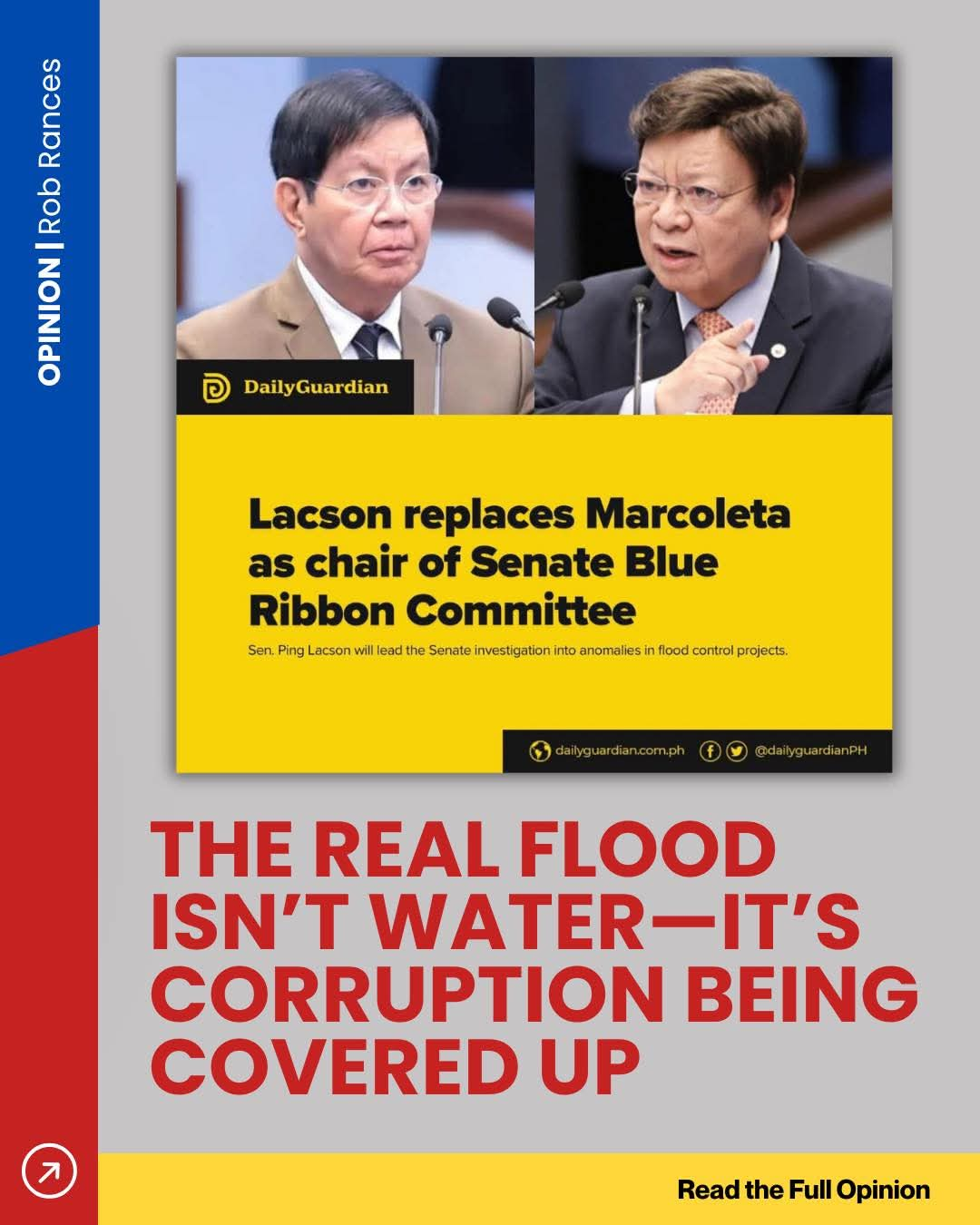
“Protect the institution.”
Observers suspect it was the whispered rationale for the lightning-fast Senate leadership shift after the Blue Ribbon hearings detonated.
Chair Marcoleta’s committee, backed by the notarized confession of the Discaya couple, dared to name names: House Speaker Martin Romualdez, Rep. Zaldy Co, and a kickback culture tied to insertions and unprogrammed funds.
But instead of the House absorbing the heat, the Senate’s leadership bore the blow. Chiz Escudero was out, Tito Sotto was in, with 15 votes smoothly cast. And Marcoleta was replaced by Lacson as Blue Ribbon Committee Chair. The stated rationale? Allegedly, to “protect the institution.”
Yet here lies the paradox: when “protect the institution” means silencing its own accountability mechanisms, it stops being protection—it becomes complicity.
I. A CONFESSION THAT CRACKED THE DOOR
The Discaya couple’s testimony confirmed what the public has long suspected. With courage, they revealed a 25% kickback culture tied to insertions and unprogrammed funds—placing Romualdez and Co’s names on record. Their words pulled back the curtain on a system already hinted at by VP Sara’s exposé months ago, but which few in the halls of power have dared to confirm.
And remember: they were just one contractor. Their testimony covered hundreds of projects. But in a system handling thousands annually, how many more stories remain untold?
What stunned many was that such a breakthrough was met not with action for reform, but with political realignment. For what? Let me guess: protect the institution?
II. KICKBACKS AS BUSINESS AS USUAL
The Discayas didn’t describe a shocking anomaly. They described what ordinary Filipinos already know:
- Contractors expected to hand over 20–25% just to get a project moving.
- Agencies and politicians demanding under-the-table payoffs for approvals, signatures, and silence—siphoning even more from project funds.
- Result: Projects weakened at the root, leaving communities vulnerable to collapse and floods.
This is corruption normalized, defended, and ironically “protected.” When exposed, the instinct of many isn’t reform but retreat, lest too many get dragged down with the tide.
III. THE TIP OF THE ICEBERG
Here’s the sobering reality:
- Current Senate exposés have only touched flood-control projects.
- Roads, bridges, classrooms, hospitals—untouched.
- Other agencies—untouched.
- The GAA insertions, unprogrammed allocations, and the “small committee” tweaks—not yet fully scrutinized.
If one sector already forces leadership changes, what happens when the entire infrastructure budget is exposed? How many more institutions will need “protecting” and at what cost to truth?
IV. WHEN PROTECTION BECOMES DESTRUCTION
Institutions don’t collapse because people rage outside, they collapse because rot eats them from within.
Every time leaders say “protect the institution,” yet use it to avoid accountability, they corrode the very foundation they claim to defend. It’s not the people’s anger that kills institutions—it’s insiders shielding each other in the name of survival.
History has shown this pattern before: the facade of unity masking decay, until the whole structure caves in.
V. THE COST OF THIS GAME
To ordinary Filipinos, “protect the institution” doesn’t mean much. What they feel is the cost:
- A road that cracks after one rainy season.
- A flood-control wall invisible in their district.
- A classroom promised but never built.
Every peso hidden behind institutional protection is a peso stolen from survival.
To the people, the Senate leadership shuffle wasn’t about preserving dignity, it was about politicians saving themselves while families wade through floodwaters.
VI. THE FORESIGHT WE CANNOT IGNORE
If this instinct to “protect the institution” continues to trump accountability, expect:
- More leadership shifts to contain exposure.
- More silence from insiders too afraid kasi maraming madadamay.
- More cynicism from the public, convinced that accountability is impossible when the system circles its wagons.
But protection is a short-term fix.
Decay is a long-term certainty.
VII. THE INSTITUTION THEY CLAIM TO PROTECT
The Discaya couple cracked open the door. The Senate probe, for a moment, gave people hope. But the leadership change that followed sent another message: when corruption gets too close, protection comes first.
Institutions don’t die from attack, they die from the decay of insiders who mistake protection for preservation.
And what rots from within cannot be saved by new leadership—it can only be cleansed by truth.
The people’s rage won’t kill democracy. The danger lies in leaders so desperate to “protect the institution” that they forget what it was built for—to serve the nation, not to cover its own tracks.
•••
OPINION | ROB RANCES
Disclaimer: This commentary is an independent opinion piece intended for public discourse. It draws on publicly available reports, testimonies, and political developments to offer analysis and critique. References to individuals or institutions are based on existing media coverage and sworn statements already in circulation. The views expressed here do not assert guilt or criminal liability but highlight issues of governance, accountability, and public trust for the purpose of civic discussion.
 Pinoy Edmonton News