THE TRADE KING AND THE TWO PRESIDENTS:
Duterte Saw It Coming, Marcos Missed the Wave
OPINION | Rob Rances
Under Xi Jinping, China isn’t just a rogue wave—it’s the tidal force many Asian economies have chosen to ride rather than resist.
What used to be seen as a manufacturing monolith has evolved into a multi-engine powerhouse driving the region’s trade, technology, and transition toward sustainability.
Take Malaysia, for instance. China has been its largest trading partner for sixteen straight years, with bilateral trade surpassing $190 billion in 2024. It’s not just about electronics anymore—Chinese capital now powers industrial parks in Penang and clean-energy projects in Johor, while Malaysia’s famed durians reach Chinese markets within 24 hours through optimized logistics and digital customs systems.
Look at Vietnam. Once a manufacturing rival, it’s now a key node in China’s supply chains. Over 37% of its imports come from China, everything from machine parts to semiconductors, and nearly one-fifth of its exports flow back to Chinese-linked global production networks. Hanoi didn’t treat Beijing as an adversary; it treated it as a catalyst for growth.
Even smaller economies like Cambodia and Laos have leveraged Chinese financing to modernize transport, agriculture, and energy systems.
The China-Cambodia Free Trade Agreement pushed bilateral trade up by 24% in a single year. The China-Laos Railway has already slashed logistics costs, creating new export corridors for the Mekong region.
These aren’t fringe cases, they’re strategic alignments born from pragmatism, not politics. China is no longer just Asia’s workshop. It’s the hub of supply chains, the investor behind infrastructure, the market driving consumption, and for much of the region—the paycheck funding recovery.
I. DUTERTE’S FORESIGHT vs. BBM’S BLINDSPOT
While the rest of the region leaned into China, our leaders were busy playing geopolitical tug-of-war—confusing strategic autonomy with submission to someone else’s script.
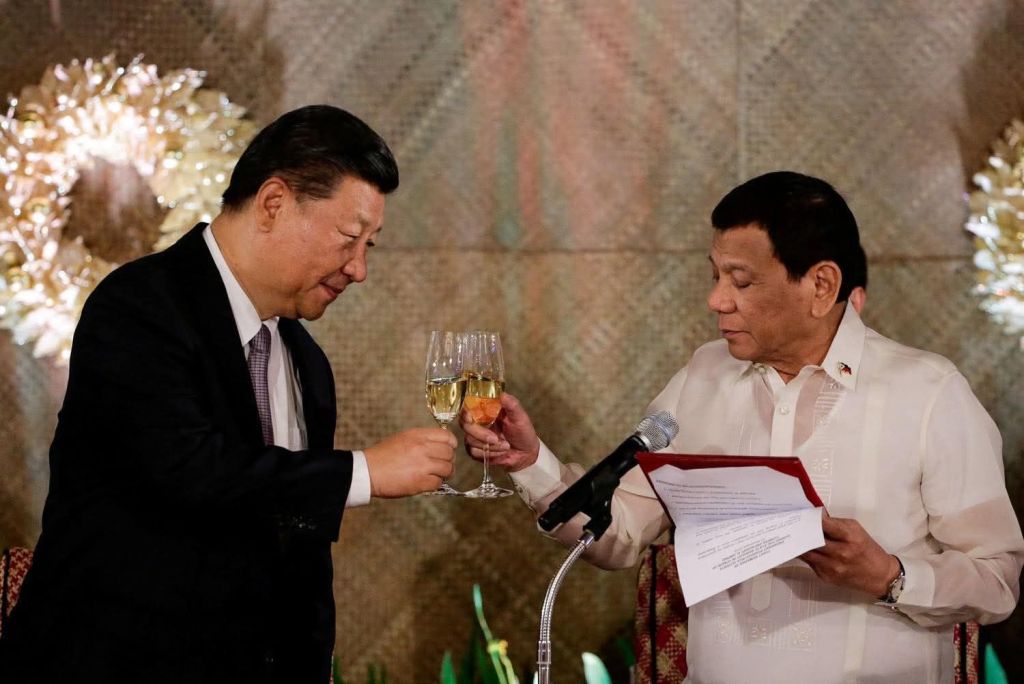
President Duterte saw early that the Philippines needed China—not to surrender sovereignty, but to expand opportunity. He recognized that prosperity and pragmatism could coexist with patriotism. His pivot toward Beijing wasn’t ideological; it was economic realism. He understood that the winds of trade had shifted east, and that playing balance between the U.S. and China was not weakness—it was statecraft. His administration secured infrastructure commitments, investments, and agricultural deals that were meant to position the Philippines in the Asian growth arc.
Enter President Marcos Jr., who inherited that geopolitical balance but quickly dismantled it with anti-China posturing dressed up as nationalism. Instead of recalibrating, he reversed. While other ASEAN leaders were signing trade deals, reviving Belt and Road projects, and negotiating energy cooperation, Malacañang was busy chasing Western validation and socmed applause.
This pivot wasn’t strategy—it was survival optics. And it cost us.
The region’s supply chains kept integrating, China’s consumer market kept expanding, and ASEAN neighbors kept cashing in. Meanwhile, the Philippines fell behind—watching the train of Asian progress leave the station while arguing over who should drive it.
Our front-row seat to Asia’s economic renaissance? Come-late, half-invited, and still trying to find the ticket counter.
II. WHY THIS MATTERS FOR THE PHILIPPINES
We’ve been too busy framing China as the villain, when the real villain might be our own complacency.
While we obsess over fear-driven diplomacy, other nations have been quietly building wealth and leverage.
• Our trade diversification is weak. Nearly 80% of Philippine exports still hinge on a few sectors—electronics, BPOs, and remittances—while our neighbors have diversified through bilateral trade with China, integrating agriculture, technology, and green energy into their export mix.
• We’re missing out on value-chain gains. Vietnam and Malaysia now assemble, process, and even design goods for both Western and Chinese markets. Meanwhile, we’re still exporting raw materials and importing finished products. In the language of economics, that’s the difference between being in the chain and being chained to the bottom.
• We’re not leading the narrative; we’re reacting to it. Every time Washington or Beijing sneezes, our policy shifts like a weather vane. Other ASEAN states balance both powers—Singapore signs defense agreements with the U.S. while raking in billions in Chinese tech investments. We, on the other hand, use sovereignty as a slogan, not as strategy.
Other countries have evolved from fear of China to growth with China. They play chess; we play checkers. And while they negotiate deals, we negotiate soundbites.
We’re stuck in fear—not just of China—but of the narrative that keeps us small, dependent, and perpetually reactive to U.S. cues.
Because the more we buy into this Cold War storyline, the less we build our own.
III. THIS ISN’T JUST ABOUT CHINA, IT’S ABOUT SOVEREIGNTY
When your neighbor becomes your biggest partner, narrative matters.
When your ally becomes your friend, freedom matters.
And when your politician uses China as the poster-child of threat, while leaning ever closer to the U.S., you gotta ask whose script he’s reading.
If the Philippines is going to thrive in this China-centred trade wave, we don’t need anti-China posturing. We need pro-Philippines strategy.
We need deals, not declarations. We need trade, not threats. We need agency, not alignment as a default.
If our leaders keep acting as if the threat-script is the strategy, we’ll watch as the Asia trade wind leaves us in its wake—while we’re still debating whether to board the ship.
•••
Disclaimer: This commentary is an independent analysis and does not represent any government, organization, or political group. It is a speculative opinion piece grounded in publicly available data, economic indicators, and regional trade developments. The discussion of China’s economic role and the contrast between Duterte’s and Marcos Jr.’s foreign policy postures is intended to encourage critical reflection on strategy and national positioning, not to advance partisanship or endorse any foreign power. I advocate for a pro-Philippines, sovereignty-centered, and evidence-based approach to foreign relations and economic policy.
 Pinoy Edmonton News