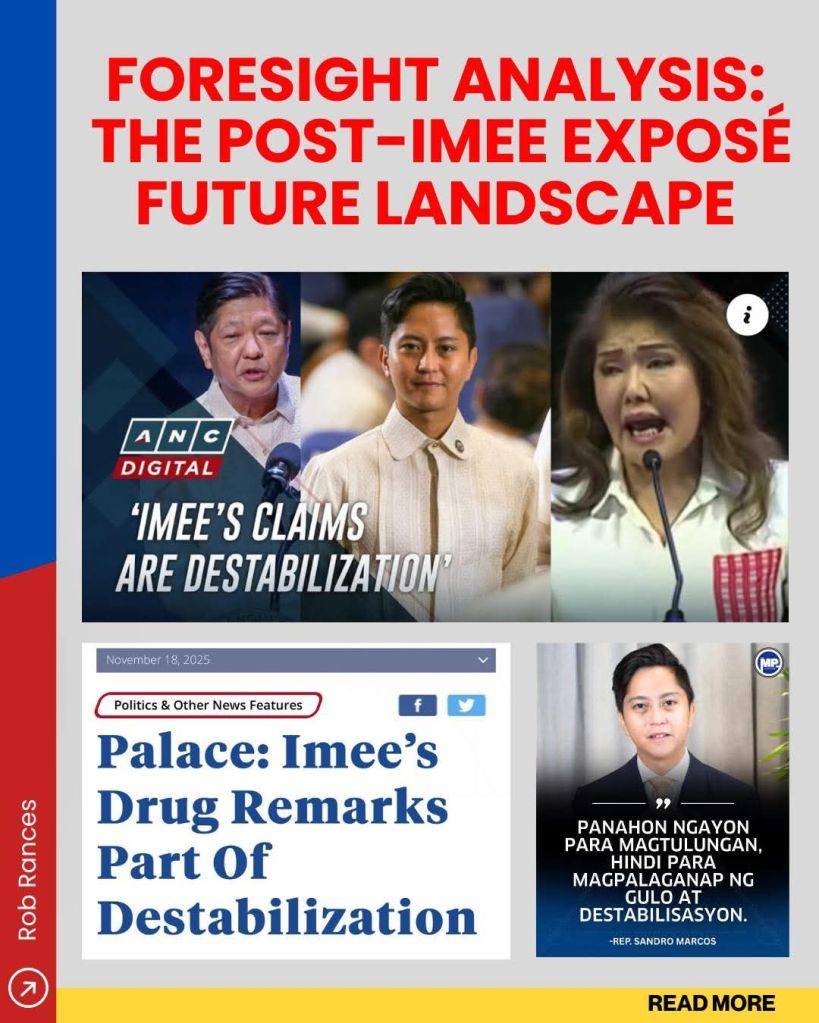
FORESIGHT ANALYSIS: THE POST-IMEE EXPOSÉ FUTURE LANDSCAPE
Three Future Scenarios
SCENARIO 1 — “ORDERLY EXIT”
TRIGGERED BY MASSIVE PUBLIC PRESSURE
BBM resigns—but only after a large, united, and sustained mass movement makes staying in office politically and personally costlier than stepping down.
Narrative:
In this updated scenario, resignation does not happen voluntarily.
Left to his own choices, BBM has already made his stance clear: He will not step down. He will frame allegations as destabilization. He will “fight it out.”
Therefore, the only conditions under which an orderly exit becomes possible are:
1. Massive, continuous street mobilizations—far larger than the current rallies—drawing middle class, church blocs, workers, students, OFW families, and barangay-level participation.
2. Broad elite convergence—business groups, retired generals, local political kingpins, and major churches aligning behind one message: “For stability, he must step aside.”
3. Institutional fatigue—Congress, the courts, and the bureaucracy calculating that BBM is now a liability, not an asset.
4. International pressure signaling instability risk—quiet but firm diplomatic nudges.
Only when these four forces converge does resignation become BBM’s least damaging choice—a survival move rather than an admission of guilt.
Thus, Scenario 1 is not a peaceful glide. It is a pressure-driven exit.
The “orderly” part only describes the mechanics of the departure—not the trigger.
Key Indicators:
• Protests scale into millions, not hundreds of thousands, across NCR and provinces.
• Religious institutions issue increasingly explicit moral calls for change.
• Business groups begin hinting that leadership change is necessary for economic stability.
• Cabinet resignations continue, especially from technocrats unwilling to be associated with the fallout.
• High-ranking local officials pivot publicly toward “nation first” messaging.
• International financial markets punish the Philippines sharply, increasing pressure on economic managers.
When these indicators reach a tipping point, the Palace faces a choice:
Cling to power and risk total collapse, or…
Accept a negotiated, face-saving exit framed as medical leave, rehabilitation, exhaustion, sacrifice for the nation, or any narrative that preserves some dignity.
That is the moment Scenario 1 becomes possible.
Implications:
• Short-term calm after the step-down
Because mass movements feel victorious and institutions prefer stability. Markets rebound.
• Sara Duterte (or constitutional successor) consolidates quickly. Riding the legitimacy of public sympathy.
• Romualdez bloc loses power dramatically
Their political capital drains as investigations deepen.
• Marcos family enters long-term fracture
The Imee–BBM split becomes irreversible.
Risk & Impact:
• Risk (likelihood): Medium–Low in the immediate term. Medium in the medium term—not because BBM wants to resign, but because public pressure may eventually make it his least painful option.
• Impact: High. A pressured but peaceful transition prevents collapse and restores institutional function.
Bottom Line:
A clean, voluntary resignation is not realistic. A pressured, negotiated exit is, but only if:
The people, the churches, the elites, and the institutions move in the same direction—and keep moving long enough to make staying in power harder than leaving.
SCENARIO 2 — “THE SLOW COLLAPSE”
RESISTANCE → EROSION → INEVITABLE SHOWDOWN
BBM refuses to resign despite intensifying scandals; the crisis drags on, deepens, and eventually forces institutions to act—not because they want to, but because they can no longer avoid it.
Narrative:
Because BBM is unwilling to step down unless cornered by overwhelming public pressure, Scenario 2 becomes the default slide—the long, painful path where:
• BBM digs in,
• Malacañang denies everything,
• corruption investigations widen,
• congressional allies wobble but do not move decisively, and
• protests continue but do not yet reach the “tipping point” needed to force an exit.
This is the scenario where everything stagnates, then slowly collapses, like a structure cracking from within.
BBM admin frames the situation as:
• “lies,”
• “political noise,”
• “destabilization,”
• “efforts to derail my anti-corruption purge”
And positions himself as the “target” of a coordinated takedown.
Meanwhile, Zaldy Co’s revelations continue to bleed out credibility, House probes clash with public outrage, and new leaks and testimonies keep emerging—each one chipping away at the President’s legitimacy.
The danger here is not sudden chaos. The danger is a slow, grinding, institutional suffocation.
Resignation won’t happen here.
Instead, the system drags toward impeachment, institutional breakdown, or a forced transition months down the line.
Key Indicators:
1. Congress Hesitates—but Cracks Begin to Show
• House leaders insist on “due process” while quietly distancing themselves.
• Senate begins to talk more openly about probing BBM’s role in budget insertions.
• Privately, blocs begin exploring impeachment even if they deny it publicly.
2. More Cabinet Resignations
Not explosive all at once, but strategic drip-drop exits signaling:
“We don’t want to go down with this ship.”
3. Sustained but Not Yet Massive Protests
People keep marching. Church and civic groups join. But numbers still fall short of a full tipping-point tsunami.
This is the key distinction from Scenario 1: pressure is high—but not yet overwhelming.
4. Growing Elite Neutrality
Business, diplomatic circles, and political clans increasingly position themselves as:
“We support accountability. Whoever it hits.”
This is a sign that BBM’s support is hollowing out.
5. Market Drag + Economic Anxiety
Peso down.
Stocks unstable.
Investments on pause.
Government messaging sounds increasingly disconnected from economic reality.
When money becomes nervous, politics becomes fragile.
6. Rising Leaks from Malacañang and Congress
Documents. Voice notes. Anonymous officials confirming internal chaos. When leaks accelerate, collapse is underway.
Implications:
1. Governance Paralysis
Nothing moves. Budget execution stalls. Infrastructure stops. Policies freeze while scandals multiply.
2. Public Anger Hardens
Not the explosion of Scenario 1, but a deepening resolve in the middle class, provinces, schools, and churches. This is where resignation becomes inevitable later, not now.
3. Congress Shifts from Defense to Self-Preservation
Once BBM becomes too costly, political blocs slowly reposition:
• First: “We support due process.”
• Then: “Let the investigations continue.”
• Finally: “No one is above the law.”
By the time they reach that last line, BBM is already in political freefall.
4. AFP Pressure Increases—But Quietly
In Scenario 2:
• AFP stays neutral publicly.
• Privately monitors tension, refuses politicization, prepares for stability contingencies.
No intervention—but increasing refusal to be used. This is the military version of “slow collapse.”
5. Impeachment Becomes the “Respectable Exit”
Unlike Scenario 1 (pressured resignation), Scenario 2 ends with institutions forced to move because markets weaken, governance stops, legitimacy collapses, and protests refuse to die.
Impeachment begins not with moral courage—
but with political survival.
Risk & Impact:
• Risk (likelihood): Very High. This is now the most probable near-term trajectory.
• Impact: Extremely High. Because the crisis drags out for months, hurting governance, markets, institutions, and social cohesion.
Bottom Line:
Scenario 2 Is the “natural” path from here because:
• The Palace refuses resignation.
• The people are mobilized but not yet at critical mass.
• Congress is scared but not yet unified.
• Elite blocs are shifting but not yet aligned.
• Markets are shaking but not yet collapsing.
• AFP is neutral but not yet alarmed.
Scenario 2 is the pressure cooker: slow, painful, corrosive until one final spark pushes the country to either Scenario 1 (pressured exit) or Scenario 3 (authoritarian gambit).
SCENARIO 3 — “THE DESPERATE GAMBIT
DEFENSIVE AUTHORITARIAN PIVOT
BBM clings to power by escalating the crisis into a “national security” issue—testing how far he can stretch fear, coercion, and state machinery to survive.
Narrative:
In this pathway, BBM does not resign. Does not allow an easy impeachment. Does not allow the system to drift toward a slow death.
Instead, Malacañang attempts to flip the crisis:
From “legitimacy collapse” to “threat to national security.” And they try to survive by reshaping the battlefield.
How?
By ramping up these moves:
1. Destabilization Narrative Becomes the Centerpiece
This already started. The Palace frames ouster calls, Imee’s accusations, and Zaldy Co’s videos as:
• foreign-backed destabilization,
• coordinated demolition jobs,
• sabotage of BBM’s anti-corruption campaign,
• or attempts to derail reforms.
In Scenario 3, this narrative becomes aggressive and all-consuming, used to justify extraordinary measures.
2. Selective Legal Warfare Intensifies
Government agencies may begin:
• filing cases,
• issuing summons,
• conducting audits,
• launching “anti-corruption raids” that conveniently target critics or whistleblowers.
This is the soft authoritarian playbook: weaponize legality so it looks clean.
3. Information Control Attempts
BBM’s team may try to:
• flood media with propaganda,
• deploy coordinated online defense networks,
• discredit Imee with personal attacks,
• suppress damaging leak sources,
• overwhelm the narrative with new distractions.
This is not martial law, but narrative occupation.
4. Security Sector Pressure Tests
Not outright crackdowns yet. Instead:
• increased police visibility near protest areas,
• tighter “permits to rally,”
• more checkpoints,
• legal warnings about sedition or “inciting to instability,”
• quiet monitoring of organizers.
AFP remains the wild card. If they stay strictly neutral, the Palace’s hand is limited. If they echo the Palace line, the danger escalates sharply.
5. Midnight Moves / Surprise Appointments
Another hallmark of Scenario 3:
• sudden security reshuffles,
• late-night memos,
• abrupt replacements of key individuals in AFP, PNP, NBI, DOJ, or DILG,
• creation of new “anti-destabilization” task forces.
These moves signal defensive consolidation.
6. Manufactured “Crisis Events”
To justify extraordinary measures, a desperate Palace might:
• exaggerate minor security incidents,
• highlight unverified intel about plots,
• label protests as “threats to public order,”
• orchestrate fear to justify tightened control.
This is the riskiest move because it can easily backfire and explode public anger.
Indicators:
1. Palace labels rallies as “destabilization,” “illegal,” or “terror-linked.” If this escalates into threats of sedition charges, the pivot has begun.
2. Targeted legal actions against critics or whistleblowers. If government agencies suddenly move against organizers, journalists, or insiders, it signals weaponization.
3. Security reshuffles in rapid succession. Especially if appointments appear politically loyal rather than professionally qualified.
4. Increased police presence at protest zones + intimidation tactics. Not outright violence, but theatrics of fear.
5. Sudden restrictions on permits, transport, or public gatherings. Classic soft-lockdown of dissent.
6. Strong rhetoric invoking “national security emergencies.” If BBM starts invoking “peace and order,” “threats to stability,” or “protecting the Republic,” the gambit is underway.
Implications:
1. Massive Public Backlash
If people sense repression—rallies swell, churches activate, middle class mobilizes, provinces follow NCR’s lead.
Fear doesn’t silence Filipinos. It enrages them.
2. Institutional Pushback
Scenario 3 provokes institutions into action:
• Courts issue TROs on abusive acts.
• Senate pushes deeper probes.
• House reconsiders impeachment as a safety valve. Ombudsman / COA assert independence. AFP, if pushed too far, refuses orders that endanger civilians.
This scenario can turn abuse → backlash → collapse.
3. Economic Shock
Markets respond immediately:
• peso drops,
• PSE plunges,
• foreign investors freeze plans,
• economic managers panic.
Scenario 3 is economically suicidal.
4. International Alarm
Global media coverage intensifies:
• “Philippines political crisis deepens,”
• “Family feud destabilizes government,”
• “Anti-corruption protests swell,”
• “Security forces on alert.”
Foreign governments quietly warn against excessive force.
5. Risk of Accidental Escalation
Scenario 3 is inherently unstable: one violent dispersal, one death, one illegal arrest, one viral video of brutality…
…and the entire crisis detonates into a Scenario 1-level mass movement.
Scenario 3 often ends not with regime consolidation—but with public fury forcing a reckoning.
Risk & Impact:
• Risk (likelihood): Medium. The Palace is already using “destabilization” language—but the AFP’s current neutral stance and global scrutiny limit the regime’s maneuver space.
• Impact: Severely High. This scenario causes the fastest economic damage and the largest, angriest mobilizations.
It is the most dangerous for the Republic, and ironically, the most likely to force a sudden exit if the Palace miscalculates.
Bottom Line:
Scenario 3 is dangerous—but self-defeating because BBM cannot solve the crisis. He can only deny, delay, distract, or repress.
But every move in Scenario 3:
• increases public anger,
• accelerates elite fragmentation,
• destroys investor confidence,
• forces institutions to defend their credibility,
• and speeds up the path toward involuntary transition.
Scenario 3 is not a survival strategy. It is a countdown to collapse, unless the administration pulls back early.
••••
FORESIGHT ANALYSIS | ROB RANCES
Disclaimer: This foresight analysis does not predict events, accuse anyone, or assert any facts about individuals or institutions. It outlines possible scenarios based on publicly available information, observable trends, and standard strategic foresight methods. All scenarios are hypothetical, non-partisan, and intended solely to help readers understand potential pathways and prepare for developments peacefully and constitutionally. This analysis should not be interpreted as promoting, endorsing, or calling for any unlawful action.
 Pinoy Edmonton News