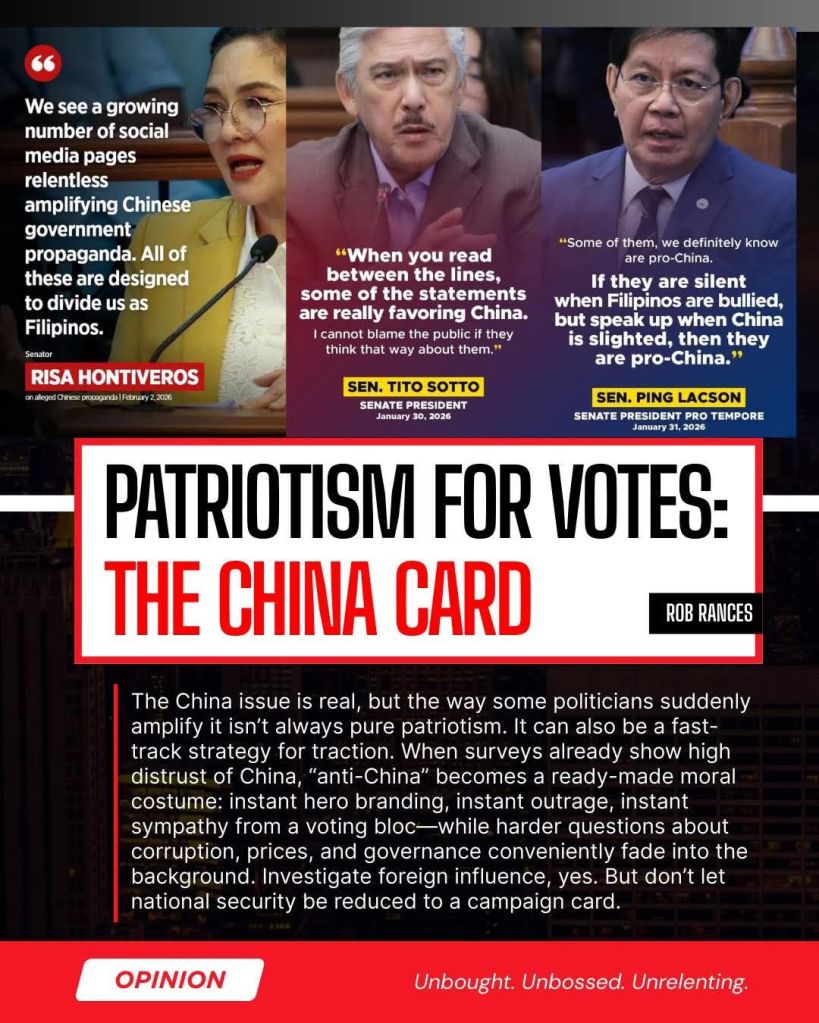
The “China issue” is being used as an election accelerant—not because patriotism is fake, but because fear-and-pride is the fastest way to manufacture moral authority, recruit a voting bloc, and reframe domestic failures into a clean, emotionally satisfying fight.
And yes, eto mismo ang dahilan kung bakit nakikita mong karamihan sa anti-Duterte-aligned voices biglang todo-kapit sa “China buzz” online.
I’m not denying any real security concern. What I’m pointing out is that, politically, “China” is the easiest shortcut to three things every candidate wants: traction, moral righteousness, and a ready-made enemy.
I. WHY “CHINA” IS THE PERFECT CAMPAIGN FUEL
The public mood is already primed. Surveys consistently show high distrust toward China among Filipinos: meaning the emotional groundwork is already laid. In late 2025, OCTA’s Tugon ng Masa reported that six in ten Filipinos distrust China. 
So what happens when a politician presses the “China button”?
They get instant:
- Fear response (“threat”)
- Identity response (“patriot”)
- Tribal response (“who’s with us?”)
- Moral response (“good vs bad”)
In neuropolitics, it’s a jackpot: high emotion + clear villain + group belonging.
That’s how messages spread. That’s how “emotional memory” is formed.
And here’s the crucial part. A voting bloc already exists that is highly resistant to anything perceived as “pro-China.” A Pulse Asia survey reported by The Philippine Star found most Filipinos wouldn’t support pro-China candidates in the 2025 polls. 
Ibig sabihin ang “anti-China posture” isn’t just geopolitics. It’s also market fit. Kaya gigil ang mga pulitiko na sakyan ito.
II. THE SPIN: HOW “PATRIOTISM” BECOMES POSITIONING
This is the play:
1) Externalize the conflict
When governance is messy—prices, corruption, services—those are slow fights. Complicated. Kailangan ng receipts.
But “China”? Simple story. Instant clarity. Viral by default.
- So instead of:
“Why are we bleeding domestically?” - The conversation becomes:
“Who is pro-Philippines vs pro-China?”
And suddenly, you don’t have to answer hard questions about domestic performance. You only have to project loyalty.
2) Moral posturing
“China” allows a candidate to stand in a spotlight and say, in effect “I’m the defender.”
No long policy explanation needed. No messy systems talk needed. Just a clean identity claim.
3) Delegitimization by association
Napansin nyo ba? Tina-tag nila agad ang critics as:
- “amplifiers”
- “propaganda pages”
- “dividers”
Bakit? Para hindi na kailangan makipag-debate sa tunay na issue. Isang label lang, tapos. They’re turning dissent into “disloyalty.”
And that’s why Sen. Risa Hontiveros’ framing hits so hard in the public arena. As reported by ABS-CBN News, she warned about a “growing number of social media pages” “relentlessly amplifying Chinese government propaganda” and said these are “designed to divide us as Filipinos.” 
Again, it may be rooted in legitimate concern.
But politically, that framing also creates a moral ladder:
- I am the protector.
- My opponents are reckless or compromised.
- Those who disagree might be tools of a foreign agenda.
Lagi nating naririnig yan, di ba? That’s not just patriotism. That’s campaign-grade narrative engineering.
III. BUT ISN’T ‘CHINA’ ISSUE REAL?
Lahat ng foreign influence efforts are real. And anyone serious about sovereignty should treat them seriously.
My argument is not: “Ignore foreign propaganda.”
My argument is: don’t let politicians weaponize the fear of foreign propaganda as a substitute for domestic accountability.
Simple lang ang point dito. If someone is loud on China but quiet on issues like corruption, weak prosecution, or the President’s alleged substance abuse… then we’re seeing may be less “defense of the nation” and more defense of a brand.
Grabe kung sumigaw ng “sovereignty”—pero sovereignty isn’t a costume you wear kapag papalapit na ang eleksyon.
IV. THEIR REAL OBJECTIVE: CAPTURE SYMPATHY + AUTHORITY
Sinasakyan kasi itong “China conflict” para gawing sympathy machine. Kasi it paints the candidate as courageous, morally upright, under siege, and defending the people.
And it recruits a voting bloc that already leans emotional on the issue, because fear of an external threat creates fast solidarity. And that solidarity is valuable, especially when the candidate’s coalition is fragile, or when their other narratives aren’t landing.
So yes, this can be election positioning. Again, I’m not saying the security issue is fake—pero observe the timing, the tone, and the viral framing that reveal a second purpose: traction.
FOR OTHER GROUPS NA GUSTO NG COUNTER-MESSAGE WITHOUT DEFENDING CHINA, pag-usapan natin, pero hindi dito sa social media.
We still need to investigate foreign propaganda—whether from China or the US. But don’t use China as a broom to sweep local corruption under the rug. Kung tunay kang pro-Philippines, dapat parehong tapang laban sa external threat at laban sa corruption. Because the truth is: a nation collapses more easily from internal leakage than external pressure.
I don’t doubt many officials feel real concern about China. But I refuse to pretend elections don’t shape incentives.
So I’ll say it as plainly as I can. When politicians discover that “China outrage” wins applause faster than “anti-corruption reform,” they will choose applause, unless citizens demand standards.
And that’s on us.
Not tribal. Not gullible. Not blind.
•••
OPINION | ROB RANCES
Disclaimer: This is an opinion piece and messaging analysis on election narratives. It does not claim to know anyone’s private intent, and it does not accuse any person or group of treason or foreign coordination. References are for public-context and fair comment on matters of public interest.
 Pinoy Edmonton News