For decades before Duterte, the drug problem wasn’t a rumor. It was a governance failure with street-level victims. Syndicates embedded in communities, local protection networks, and narco-influence weren’t created in 2016.
The wound existed long before him.
Duterte didn’t break the nation; he walked into a nation that already had rot in its arteries, and he chose to confront what many administrations preferred to manage quietly.
THE DRUG WAR: CONTEXT THAT’S OFTEN REMOVED ON PURPOSE
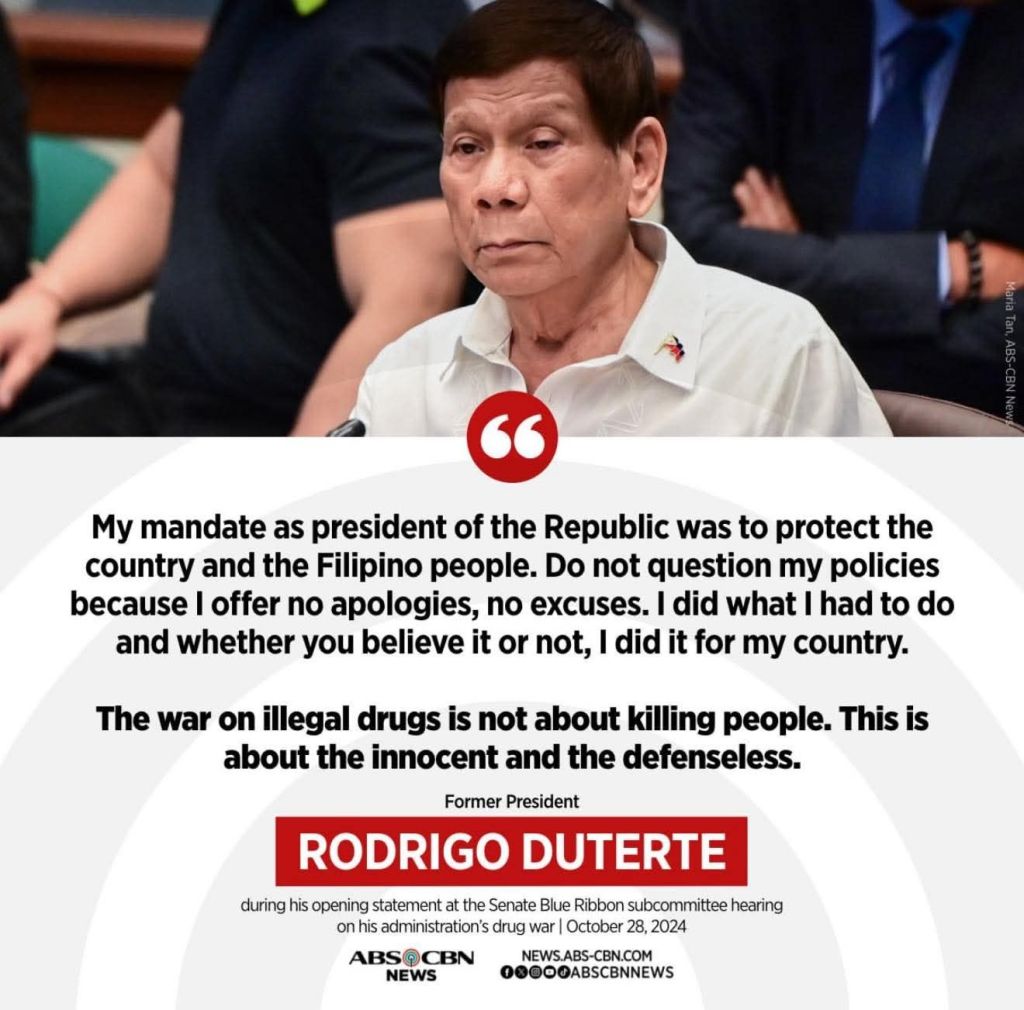
Yes, people died in the drug war. No honest person denies that. But what the public debate often deletes is the scale of the pre-existing drug footprint and why millions of Filipinos, especially in vulnerable communities, experienced the crackdown as relief.
Government anti-drug reports during the Duterte years repeatedly described the drug problem as nationwide and deeply embedded at the barangay level. For example, the government’s own end-term reporting noted 24,424 “drug-affected” barangays—about 58.10% of 42,036 barangays nationwide as of June 30, 2018. That figure alone tells you the key point: the problem was not “a few corners.” It was a national map.
And even after years of operations and barangay drug-clearing programs, state reporting still described a long road. As of January 2025, PDEA said 69.97% of barangays were “drug-cleared,” meaning the system itself acknowledges how widespread the challenge had been and how long institutional cleanup takes. 
The enemies Duterte confronted were real, organized, and violent. And they had incentives to fight back politically and narratively.
THE PART MANY ELITES DON’T WANT TO ADMIT
The simplest reason Duterte’s drug war remains politically combustible is that it didn’t only hit street pushers. It threatened an entire ecology: networks, protectors, cash flows, and local power arrangements.
You don’t need to agree with every method to recognize the basic political reality that when you disrupt a profitable underground economy, you also disrupt people who had been benefiting from its protection or tolerance. That is why the debate is never purely moral; it’s also about lost leverage.
THE COUNTRY FELT SAFER
During Duterte’s term, police-reported “focus crimes” (the eight major index crimes) were repeatedly cited as declining in official data—one PNA report, quoting PNP figures, said focus crimes fell steeply from 2016 levels to 2021. Separate PNP reporting carried in mainstream media also claimed reductions in total crime volume and focus crimes across specific years within the period. 
Many households reported a felt change in everyday security, and political support tends to follow felt experience more than elite argument.
That’s also why Duterte’s approval ratings stayed high across much of his presidency per Pulse Asia summaries and reporting. You don’t sustain that kind of public standing through “magic.” You sustain it because millions believed that the state was finally acting against something that had been left to fester.
THE REAL DANGER NOW: AMNESIA
The most strategically dangerous thing happening today is selective forgetting—forgetting why the drug war became politically possible in the first place.
When governance weakens, when corruption resurges, when institutions act hesitant or captured, the old ecosystem doesn’t vanish, it reconstitutes. And once communities feel that old fear again, the public doesn’t ask for elegant academic debates. They ask the brutal question:
“Who will protect us?”
THE EXISTENTIAL QUESTION
Protecting a nation requires courage, confrontation, and institutional spine. Duterte became politically dominant because he offered what prior leadership often refused to offer: a posture of confrontation against a problem many citizens experienced as daily terror.
You can condemn the costs. You can debate the methods. But you cannot erase the reason millions rallied behind him. The darkness was already there. He just chose to fight it.
•••
OPINION | ROB RANCES
 Pinoy Edmonton News