March 11, 2025. The country watched one of the most extraordinary political events in recent Philippine history unfold.
Former President Rodrigo Roa Duterte was arrested at Ninoy Aquino International Airport by Philippine authorities in connection with an International Criminal Court process. Within a day, he was no longer in the country. The ICC announced that he had been transferred to its custody in The Hague.
Whether one supports Duterte or not, that moment instantly raised questions far larger than one man.
Questions about sovereignty. Questions about due process. Questions about whether the Executive branch had acted within the limits of the Constitution. Those questions were brought to the Supreme Court of the Philippines through petitions questioning the legality of the arrest and surrender.
One year later, the country is still waiting for the Court to answer them.
And now something deeply uncomfortable has happened.
A foreign voice has begun asking the questions our own institutions have yet to resolve.
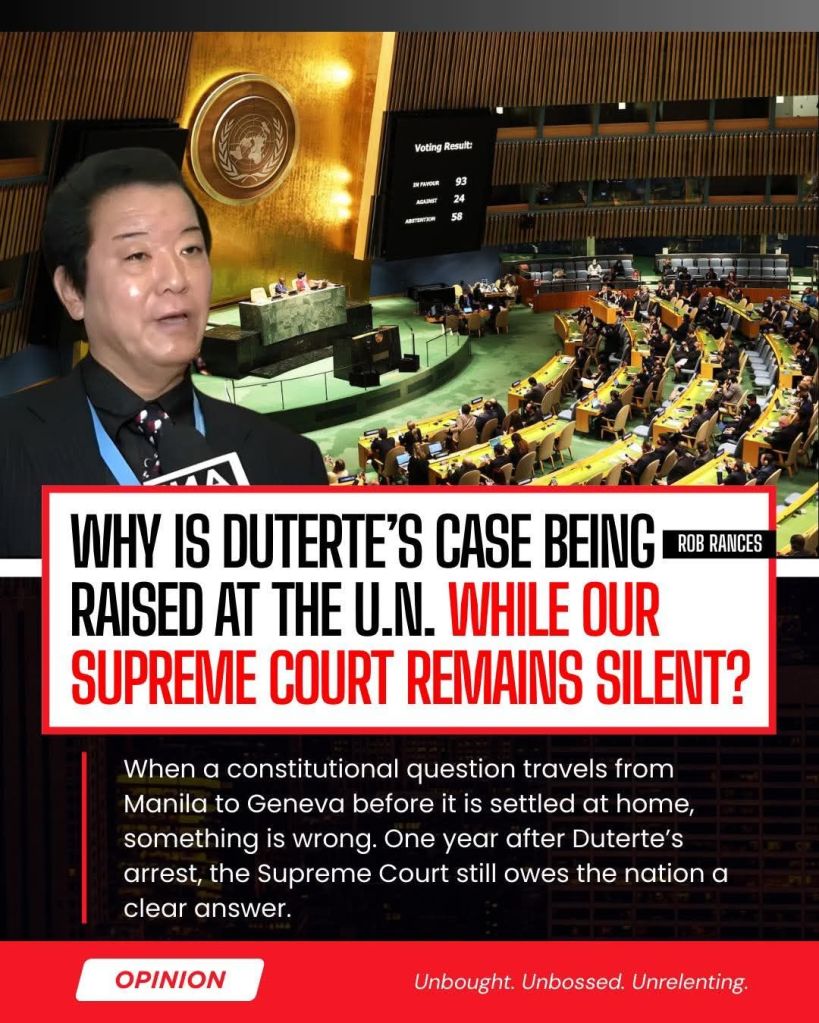
On March 11, 2026, during a session of the United Nations Human Rights Council in Geneva, Japanese researcher Shunichi Fujiki raised Duterte’s detention before the international community. Speaking as a representative of the International Career Support Association and a researcher affiliated with the International Research Institution of Controversial Histories (iRICH), Fujiki argued that Duterte’s continued detention was unjust and politically motivated.
He questioned why the International Criminal Court was intervening when no domestic trial had taken place in the Philippines. He raised concerns about sovereignty. He suggested the case could be interpreted as political persecution connected to the country’s internal power struggle.
You may agree with him. You may disagree with him. But that is not the point.
The point is that a year after Duterte’s arrest, it was a Japanese researcher speaking in Geneva who publicly pressed the question of legality, while the constitutional referee inside the Philippines has yet to give its final answer.
And that should trouble us.
Because the issue here is not whether Fujiki is right or wrong. The issue is why the constitutional question he raised is still unresolved in the only place where it truly belongs: the Philippine Supreme Court.
The Court has not ignored the petitions. It consolidated them. It required responses. It identified the legal issues. The parties submitted memoranda after the Court’s November 11, 2025 resolution framing the questions to be decided.
The process has moved.
But the one thing that matters most, THE FINAL CONSTITUTIONAL RULING, has not yet arrived.
And in matters like this, delay does not sit quietly in the background.
Delay shapes the political reality.
When the Executive can act quickly—arrest, surrender, transfer custody across continents—while constitutional review arrives only after the act is already complete, the balance between power and law begins to look inverted.
The Constitution was never designed to chase events after they happen. It was designed to draw the line on what government is allowed to do. That is the duty the Court itself recognizes. Judicial power includes determining whether any branch of government committed grave abuse of discretion.
Which brings us back to the uncomfortable spectacle we witnessed last week.
A foreign researcher speaking before the UN Human Rights Council raised humanitarian and legal concerns surrounding Duterte’s detention.
While the Filipino people are still waiting for their own Supreme Court to tell them.
That is not how a sovereign republic should look to the world.
A nation’s constitutional questions should be answered by its own courts, not debated internationally BECAUSE DOMESTIC CLARITY HAS NOT YET ARRIVED.
If the arrest and surrender of Duterte were constitutional, then the Court should say so plainly and decisively. Let the doctrine be written. Let the legal argument end on Philippine constitutional grounds.
If they were unconstitutional, then the Court should say that as well, while accountability still carries meaning.
But DECIDE.
Because every additional month without a ruling allows speculation, suspicion, and political interpretation to fill the vacuum that only constitutional judgment can close.
And the longer that vacuum remains, the more the world will ask questions about our institutions that we ourselves have yet to answer.
The Supreme Court does not owe any political faction a victory.
But it does owe the Republic something far more important: CLARITY.
Clarity about the limits of executive power.
Clarity about sovereignty.
Clarity about what the Constitution actually allows.
One year after March 11, 2025, the country—and now the international community—is still waiting.
The question is no longer whether the Court knows the stakes. The question is whether the Court will speak before the silence itself begins to speak for it.
•••
OPINION | ROB RANCES
Disclaimer: This opinion is based on publicly reported statements and publicly available Supreme Court case developments. It does not assert wrongdoing or bad faith by any justice or institution but raises a legitimate public-interest question about judicial timeliness, constitutional clarity, and the importance of domestic resolution of sovereignty-related legal disputes.
 Pinoy Edmonton News