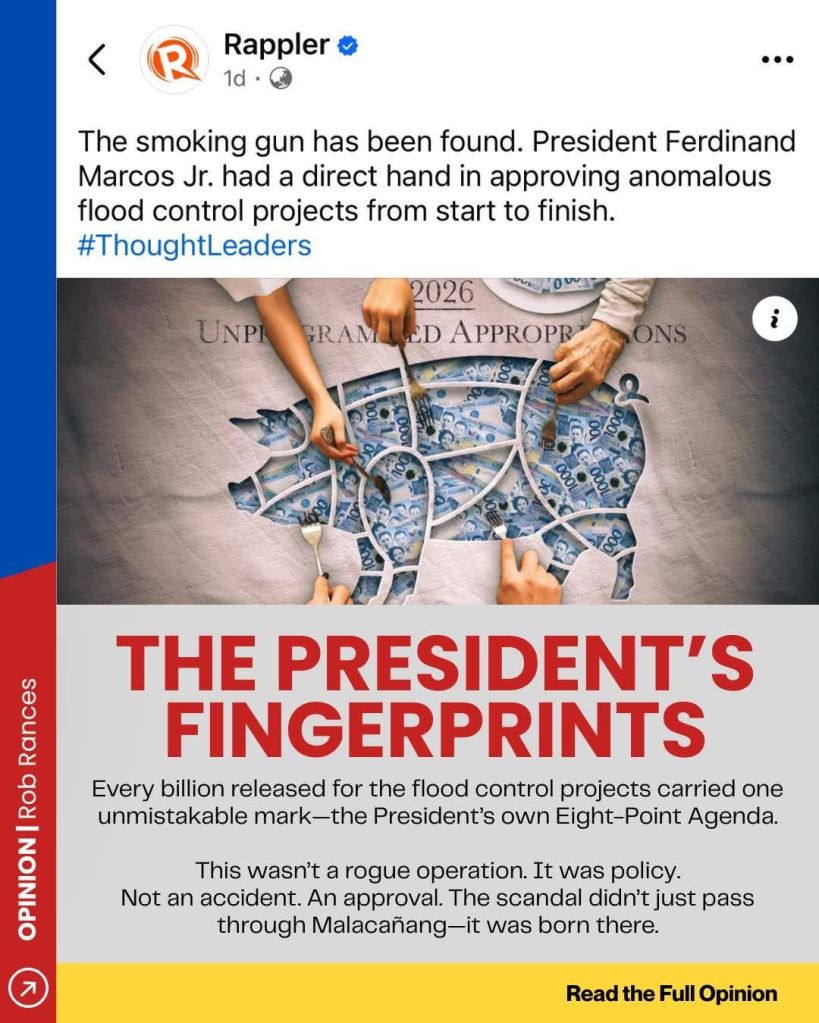
The recent PCIJ report raises grave questions.
Every Special Allotment Release Order (SARO) issued by the Department of Budget and Management (DBM) for the flood-control projects explicitly cited the President’s Eight-Point Socioeconomic Agenda as justification.
That detail changes everything.
Because it suggests these projects didn’t just pass by Malacañang—they were approved, endorsed, and authorized under the President’s own policy framework.
From the crafting of the National Expenditure Program (NEP), the blueprint of government spending, to the release of SAROs unlocking ₱213.8 billion in unprogrammed funds, the President’s involvement is institutionally undeniable, at least in principle.
This was not a rogue DPWH operation. This was not “abuse by subordinates.” It appears to have followed a policy direction. Documented, deliberate, and traceable to the highest level of executive approval.
Each flood-control project tagged as “crucial to achieving the President’s agenda” functioned as a form of presidential endorsement.
The DBM could not have released those funds without that justification. And that’s what pierces the very core of presidential accountability.
Because under the 1987 Constitution, the President is the chief architect of the budget. Every centavo released under the highly discretionary “unprogrammed appropriations” still falls under the principle of presidential control. Meaning, no agency acts independently of that authority.
So let’s stop pretending he didn’t know.
The “I didn’t see it” defense doesn’t work when your signature sits at the start and end of the process.
Either he’s terribly corrupt for allowing it, or terribly incompetent for missing it. And either way, the nation loses. Because when billions are stolen under the banner of “presidential priorities,” what dies first isn’t just trust in the leader, it’s faith in the law itself.
The floodwaters may rise and fall, but it’s this kind of governance that will finally sink the nation.
••••
OPINION | ROB RANCES
Disclaimer: This commentary is based on publicly available reports and documents, including the findings of the Philippine Center for Investigative Journalism (PCIJ) and statements from the Department of Budget and Management (DBM). It reflects an analysis of publicly reported information and does not allege criminal liability or guilt. All individuals mentioned are presumed innocent unless proven otherwise in a court of law. The discussion is intended for public education and civic discourse on issues of transparency, governance, and accountability under the 1987 Philippine Constitution.
 Pinoy Edmonton News