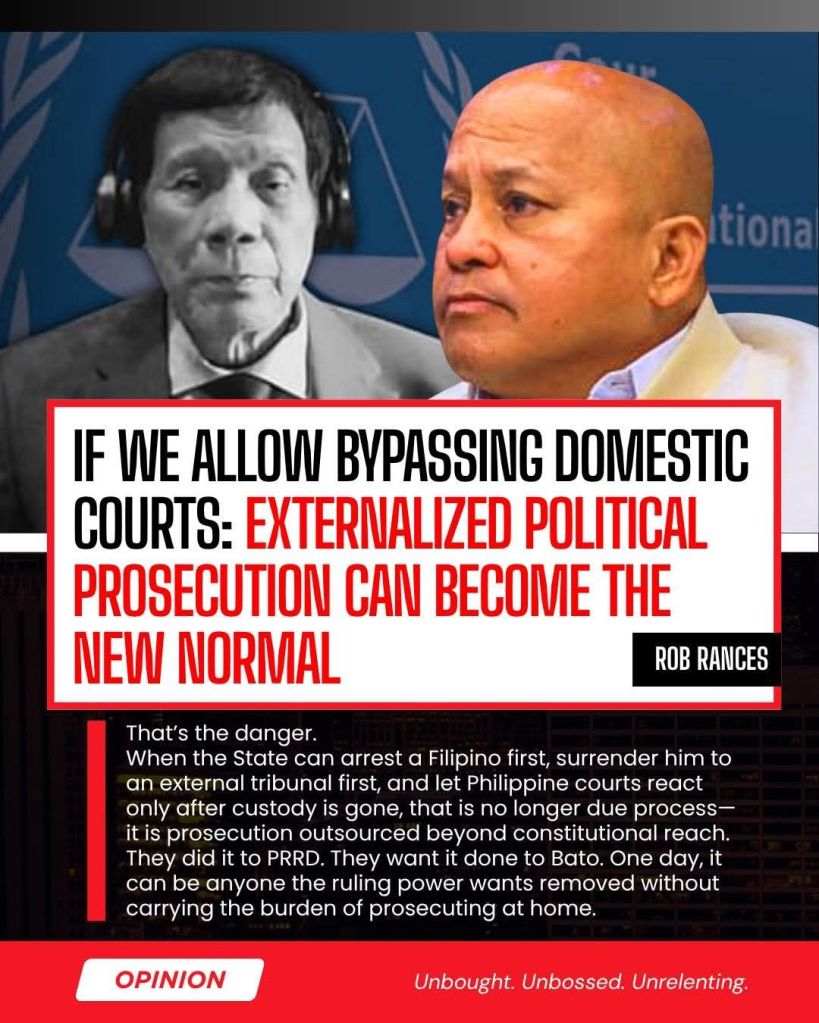
We no longer have to imagine this as a future risk. We are already watching the logic unfold.
Former President Rodrigo Duterte was arrested and surrendered to the ICC in March 2025. Now, Senator Ronald “Bato” dela Rosa is also facing an ICC arrest warrant, once again forcing Philippine institutions into a dangerous collision between external process, domestic courts, and constitutional safeguards.
When the government says: “We are merely complying.”
We must ask: Complying how? Through what Philippine legal process? With what judicial authorization? Under what domestic procedure?
Because if “compliance” means arrest first, surrender first, fly the accused out first, and let Philippine courts catch up later, then accountability is no longer being tested first through our own constitutional system.
It is being externalized.
And that is the danger.
I. OUR COURTS MUST NOT BECOME AN AFTERTHOUGHT
Even under the Rome Statute framework, arrest and surrender are not supposed to operate in a legal vacuum. Domestic law still matters. The custodial state still has procedures. Rights still have to be respected. Courts still have a role.
That means the issue is not whether grave crimes should be investigated. They should be.
The issue is not whether victims deserve justice. They do.
The issue is whether Philippine constitutional safeguards can be treated as minor inconveniences once an external tribunal has acted.
They cannot.
Because once a person is already surrendered, the Supreme Court is no longer reviewing a pending threat. It is reviewing a completed transfer.
The person is gone. Custody has been lost. The decisive act has already happened. That is the constitutional danger of “arrest first, litigate later.”
The judiciary becomes reactive, not preventive. The Court becomes a postscript, not a shield.
II. PRRD’S CASE SHOWS THE RISK
In PRRD’s case, petitions were filed before the Supreme Court challenging the enforcement of the ICC warrant and questioning the legality of the government’s actions.
But by then, the central fact had already happened. He was already out of the country. He was already in ICC custody.
That is what makes the precedent so alarming. Because once a Filipino citizen is surrendered to an external tribunal, domestic remedies become dramatically weakened. The question is no longer simply: Should the State surrender him?
But…
Can the State undo what it already did?
That is a much harder legal, diplomatic, and political question.
And now, with Senator Bato, the same danger appears again: the possibility of arrest, detention, or transfer without prior meaningful judicial authorization.
That phrase matters. “Without prior judicial authorization.” Because that is where the constitutional wound begins.
III. EXTERNALIZED PROSECUTION MAKES POLITICAL PROSECUTION EASIER
The danger is not only legal. It is political.
When the government prosecutes a powerful domestic rival locally, it must carry the burden before our own people, our own courts, our own rules of evidence, and our own Constitution.
It must file charges, present evidence, and survive judicial scrutiny. It must own the political cost.
But when prosecution is externalized, the domestic burden becomes lighter.
The government can easily excuse it:
“We are not prosecuting him. The ICC is.”
“We are not judging him. The ICC is.”
“We are not politically targeting him. We are merely complying.”
So the political prosecution becomes cleaner, faster, and harder to challenge. Simply because it can use an external process to avoid the full burden of prosecuting a domestic rival at home.
That’s the precedent we should fear.
Today, it may be Duterte. Tomorrow, it may be Bato. One day, it can be anyone.
IV. ACCOUNTABILITY MUST NOT BE USED TO BYPASS SOVEREIGNTY
The argument for ICC cooperation is usually framed as moral urgency. That there must be accountability.
That argument has force. It should not be dismissed lightly. But accountability without constitutional discipline can become another form of abuse.
A government cannot claim to defend human rights by weakening due process.
It cannot claim to fight impunity while bypassing the judiciary.
It cannot claim to respect the rule of law while treating courts as decorations after the fact.
The Constitution does not exist only for the popular. It does not protect only the weak. It exists especially when the accused is hated, powerful, controversial, or politically inconvenient. That is the test of a constitutional republic.
V. THE DANGEROUS PRECEDENT
Once this becomes normal, any future administration can face a powerful rival, avoid the burden of domestic prosecution, cooperate with an external process, and call it compliance.
The architecture is simple, as we witnessed in PRRD’s case:
• First, they framed the case as international.
• Second, they avoided full domestic judicial testing.
• Third, they surrendered him.
• Fourth, they told the public: “We only followed the ICC.”
• Fifth, the courts reviewed what had already been done.
That is not how a sovereign constitutional republic should operate.
International cooperation may be allowed, but it must pass through domestic legality. An ICC warrant cannot become a magic key that unlocks the Constitution from the outside.
VI. THE REAL RULE
The real rule should be clear: no Filipino should be arrested and surrendered to an external tribunal without prior, meaningful, and reviewable domestic judicial process.
Not because the accused is innocent. Not because the ICC has no role. Not because international crimes should be ignored.
But because sovereignty without courts becomes executive convenience.
And justice without due process becomes power wearing a legal mask.
If the State believes Duterte, Bato, or anyone else must answer for crimes, then let the evidence be tested. Let the legal basis be shown.
Let Philippine courts examine the domestic enforceability of the process before custody is lost.
Once the government can export prosecution, bypass local adjudication, and surrender citizens first while asking constitutional questions later, the country has already surrendered not just one man.
It has surrendered a safeguard.
And when safeguards fall, they do not fall only against those we dislike. They fall against everyone.
•••
OPINION | ROB RANCES
Disclaimer: This piece is an opinion and constitutional analysis intended for public discussion on issues of sovereignty, due process, judicial review, and the interaction between international tribunals and Philippine law. It does not assert criminal liability, improper motive, or unlawful conduct by any individual or institution, and recognizes that all parties and government agencies are entitled to the presumption of regularity and good faith unless otherwise determined by competent courts or official proceedings.

