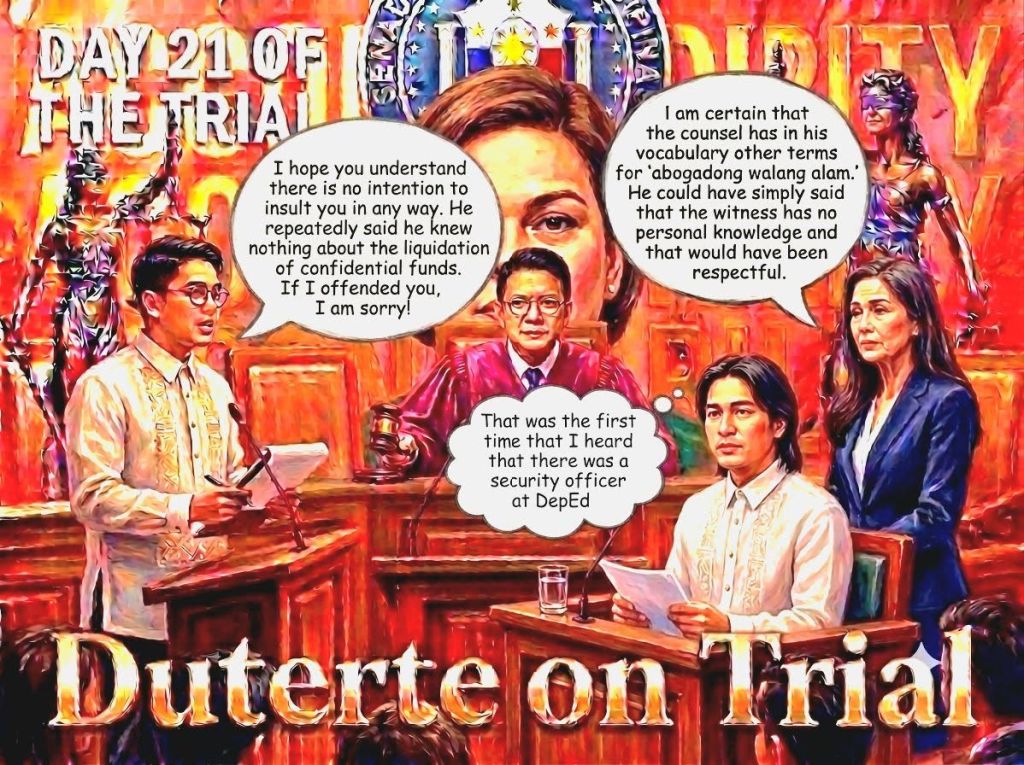
𝐃𝐀𝐘 𝟐𝟏 𝐎𝐅 𝐕𝐏 𝐃𝐔𝐓𝐄𝐑𝐓𝐄 𝐈𝐌𝐏𝐄𝐀𝐂𝐇𝐌𝐄𝐍𝐓 𝐓𝐑𝐈𝐀𝐋
By Atty.Kaloi Zarate
𝐒𝐮𝐦𝐦𝐚𝐫𝐲 | 𝐒𝐞𝐩𝐭𝐞𝐦𝐛𝐞𝐫 𝟐, 𝟐𝟎𝟐𝟔 : 𝐓𝐇𝐄 𝐋𝐀𝐖𝐘𝐄𝐑 𝐈𝐍 𝐓𝐇𝐄 𝐌𝐈𝐃𝐃𝐋𝐄 — 𝐏𝐋𝐀𝐔𝐒𝐈𝐁𝐋𝐄 𝐃𝐄𝐍𝐈𝐀𝐁𝐈𝐋𝐈𝐓𝐘 𝐎𝐑 𝐎𝐑𝐃𝐈𝐍𝐀𝐑𝐘 𝐃𝐄𝐋𝐄𝐆𝐀𝐓𝐈𝐎𝐍?
Day 21 of the impeachment trial against Vice President Sara Duterte took an unusual turn.
The prosecution called not a whistleblower, auditor, or Special Disbursing Officer, but Atty. Michael Wesley Poa—a former DepEd chief of staff and spokesperson for Vice President Duterte, and now a member of her defense team.
It was a calculated risk. Knowing Poa was hardly a friendly witness, private prosecutor Atty. Benjamin Tolosa Jr. rightfully asked the Senate Impeachment Court to declare him hostile, allowing leading questions.
But the prosecution’s purpose was not necessarily to prove through Poa where the money went.
It was to expose a more troubling question:Why was someone who admittedly did not handle, distribute, or personally witness the use of P112.5 million in DepEd confidential funds placed in the position of explaining those expenditures to the Commission on Audit?
For the prosecution, that was the problem. For the defense, that was simply how a bureaucracy works.
And therein lay the central clash of Day 21.
𝑰. 𝑻𝑯𝑬 𝑲𝑵𝑶𝑾𝑳𝑬𝑫𝑮𝑬 𝑮𝑨𝑷: 𝑾𝑯𝑶 𝑨𝑪𝑻𝑼𝑨𝑳𝑳𝒀 𝑲𝑵𝑬𝑾?
Poa admitted that he had no firsthand knowledge of the actual field operations involving the confidential funds. He did not personally handle the cash, know all the recipients, or witness the operations.
His explanations were based on reports and documents submitted by others. On its face, this is not unusual. Large government institutions operate through delegation. Senior officials and lawyers cannot personally participate in every transaction or operation.That was the defense’s point.
But the prosecution saw a dangerous gap.The person answering COA’s questions did not personally know what happened on the ground. Those who actually handled the money remained elsewhere, while the lawyer consolidated reports and explained the paperwork.
For the prosecution, this created a system of plausible deniability.
Someone conducts an operation. Someone else prepares a report. Another submits the documents. Then, a lawyer explains them.
And eventually, it becomes difficult to identify who can personally vouch for the truth of the transaction.
The prosecution’s question was therefore not whether Poa stole the money. It was simpler: If the person explaining the expenditure did not personally know what happened, who did—and who can be held accountable?
𝑰𝑰. 𝑷𝑨𝑷𝑬𝑹𝑾𝑶𝑹𝑲 𝑰𝑺 𝑵𝑶𝑻 𝑵𝑬𝑪𝑬𝑺𝑺𝑨𝑹𝑰𝑳𝒀 𝑷𝑹𝑶𝑶𝑭
The issue became sharper when placed alongside earlier testimony involving the Armed Forces of the Philippines.
Military witnesses had testified previously that AFP units did not directly receive DepEd confidential funds for activities such as Youth Leadership Summits.
Poa likewise confirmed that the funds were not directly handed to the AFP. What existed were certifications relating to military participation or attendance.
For the prosecution, that distinction mattered. A certification that military personnel attended an activity is not proof that the military received confidential funds.
Attendance is one thing. Receipt of money is another. Participation is one thing.Verification of actual expenditure is another.
The prosecution argued that supporting documents might establish that an activity took place, but they do not automatically prove that the specific amount reflected in a liquidation report was actually spent as claimed.
This raised the larger question: Was there an independently verifiable link between the cash withdrawn and the operations supposedly conducted?
Poa’s reliance on field reports only made that question more significant. If the lawyer responding to COA could not personally verify the operations, and the military did not directly receive the funds, then who could independently confirm the entire chain?
That was the evidentiary gap the prosecution sought to expose.
𝑰𝑰𝑰. 𝑷𝑼𝑩𝑳𝑰𝑪 𝑪𝑬𝑹𝑻𝑨𝑰𝑵𝑻𝒀 𝑽𝑺. 𝑷𝑬𝑹𝑺𝑶𝑵𝑨𝑳 𝑲𝑵𝑶𝑾𝑳𝑬𝑫𝑮𝑬
Another striking aspect of Poa’s testimony was the contrast between his public role and his statements under oath.
For years, Poa had publicly defended and explained the use of DepEd confidential funds. As spokesperson and senior official, he spoke with the authority expected of someone representing the administration.
But before the impeachment court, he repeatedly emphasized that he lacked firsthand knowledge of the actual operations.
The prosecution seized on that contrast. How confidently could an official publicly explain the use of millions of pesos if he had not personally witnessed or verified the operations behind those expenditures?
Were his public explanations based on facts personally known to him? Or, merely on reports supplied by others?
The defense’s answer was straightforward: that is how government communication works. A spokesperson cannot personally participate in every operation before explaining official policy. True enough.
But the prosecution’s counter-question remained:Does the same standard apply when the issue is not simply government policy, but the liquidation of millions of pesos in confidential public funds?
𝑰𝑽. 𝑻𝑯𝑬 𝑮𝑯𝑶𝑺𝑻 𝑶𝑭 𝑻𝑯𝑬 𝑯𝑶𝑼𝑺𝑬 𝑯𝑬𝑨𝑹𝑰𝑵𝑮𝑺
The prosecution also attempted to bring into the Senate trial Poa’s earlier exchanges during House investigations.
Those hearings dealt with acknowledgment receipts, supporting documents, and the paper trail surrounding the confidential funds.The prosecution wanted Poa’s previous admissions placed squarely on the Senate record—particularly his acknowledgment that he lacked direct knowledge of the actual deployment of the funds, the persons involved, and the physical handling of the money.
The defense, though, objected. It questioned the admissibility and context of video clips from congressional hearings and warned against allowing dramatic snippets to substitute for direct evidence.
The objection was understandable and not without merit.
Congressional hearings and impeachment proceedings do not necessarily follow identical evidentiary rules.
But the prosecution understood the narrative power of those earlier exchanges.The image was difficult to escape: a senior government lawyer being asked about millions in public funds and repeatedly acknowledging that he did not personally know what happened on the ground.
For the prosecution, that was not theater. That was the story.
For the defense, it was precisely the kind of political theater that could substitute optics for proof.
𝑽. 𝑻𝑯𝑬 𝑨𝑼𝑫𝑰𝑻 𝑰𝑵𝑸𝑼𝑰𝑹𝒀: 𝑴𝑨𝑵𝑨𝑮𝑰𝑵𝑮 𝑻𝑯𝑬 𝑷𝑹𝑶𝑪𝑬𝑺𝑺 𝑶𝑹 𝑺𝑬𝑬𝑲𝑰𝑵𝑮 𝑪𝑳𝑨𝑹𝑰𝑭𝑰𝑪𝑨𝑻𝑰𝑶𝑵?
Perhaps the most sensitive issue of the day involved the meeting between senior officials of the OVP and DepEd—including Poa and then OVP Chief of Staff Zuleika Lopez—and representatives of COA.
The issue was whether officials requested COA to issue an Audit Inquiry first instead of immediately issuing a formal Audit Observation Memorandum, or AOM.
The distinction was technical but important.An AOM formally records deficiencies or irregularities and becomes part of the official audit trail.
An audit inquiry is preliminary and less formal.The prosecution argued that the request suggested an effort to manage how audit concerns would initially be documented.
For them, this was about more than procedure. It was about the paper trail.
A formal AOM leaves a record, requires a formal response, and can lead to more serious audit consequences.The prosecution argued that seeking an Audit Inquiry first could indicate an effort to delay or soften the formalization of the concerns.
That mattered because it went to the issue of intent. Sloppy paperwork may be incompetence. Missing signatures may be clerical errors. But intervention in how auditors formally record their observations, the prosecution argued, could suggest awareness—and perhaps bad faith.
The defense rejected any allegation of interference. An agency, it argued, may seek clarification from COA but cannot dictate what auditors ultimately do. COA remains independent and free to issue an AOM regardless of an agency’s preference. That argument cannot simply be dismissed.
But neither can the prosecution’s question: Why was there a need to discuss how an audit concern should initially be characterized if the underlying transactions were already clear and defensible?
𝑽𝑰. 𝑷𝑳𝑨𝑼𝑺𝑰𝑩𝑳𝑬 𝑫𝑬𝑵𝑰𝑨𝑩𝑰𝑳𝑰𝑻𝒀 𝑽𝑺. 𝑶𝑹𝑫𝑰𝑵𝑨𝑹𝒀 𝑫𝑬𝑳𝑬𝑮𝑨𝑻𝑰𝑶𝑵
By the end of Poa’s testimony, two sharply competing narratives had emerged.
The prosecution’s theory: The people closest to the actual handling of confidential funds were insulated.
Poa, positioned between the auditors and the actual operations, could speak for the institution but could not personally account for the movement of the money.
His explanations were based on reports. Third-party certifications were used as supporting documents. Military witnesses said they did not directly receive the confidential funds.
And questions were raised about efforts to influence how COA initially documented its concerns.Taken together, the prosecution argued, these were not isolated lapses but a deliberate architecture of plausible deniability.
The defense’s theory: There was no architecture of concealment.There was simply an ordinary bureaucracy operating through delegation.
Poa was a lawyer, not a Special Disbursing Officer. He was not supposed to carry the money, conduct operations, or personally know every confidential detail. His role was to consolidate reports and assist in responding to auditors. Delegation is not conspiracy.
Reliance on field reports is not fraud. Requesting clarification from auditors is not obstruction. Most importantly, after hours of questioning, the prosecution had not obtained an admission that money had been stolen, converted, or pocketed.The defense’s refrain was simple: Suspicion is not proof.
𝑽𝑰𝑰. “𝑨𝑵𝑮 𝑨𝑩𝑶𝑮𝑨𝑫𝑶𝑵𝑮 𝑾𝑨𝑳𝑨𝑵𝑮 𝑨𝑳𝑨𝑴”
The tension over Poa’s role eventually boiled down to a provocative characterization strongly objected to by the defense: “ang abogadong walang alam.”
Tolosa was eventually compelled to apologize.
But beneath the controversy lay an irony neither side could escape.The prosecution argued that Poa knew too little about transactions involving millions in public funds.
The defense replied that he was never supposed to know everything because that was not his job.
Both sides, therefore, accepted the same central fact: Poa was not the actual custodian or operational handler of the confidential funds.The dispute was over what that meant.
Was his distance from the transactions an intentional buffer designed to protect those who knew more?
Or was it simply ordinary bureaucratic delegation?
Day 21 did not answer that question. But it made Poa’s lack of firsthand knowledge the battlefield itself.
𝑽𝑰𝑰𝑰. 𝑻𝑯𝑬 𝑹𝑬𝑨𝑳 𝑺𝑰𝑮𝑵𝑰𝑭𝑰𝑪𝑨𝑵𝑪𝑬 𝑶𝑭 𝑫𝑨𝒀 21: 𝑭𝑶𝑳𝑳𝑶𝑾 𝑻𝑯𝑬 𝑲𝑵𝑶𝑾𝑳𝑬𝑫𝑮𝑬 𝑮𝑨𝑷
Day 21 did not produce a dramatic smoking gun. There was no confession.
No witness declared that the money had been stolen. No document emerged directly ordering the fabrication of liquidation reports.
But important cases are not always decided by a single explosive moment. Sometimes they are decided by the accumulation of gaps.
And Day 21 was about gaps.
A gap between the person explaining the expenditure and the person who handled the money. A gap between public assurances and personal knowledge.
A gap between documentary certifications and proof of actual disbursement.
A gap between field reports and independent verification. And, ultimately, a gap in the chain of accountability.
The prosecution is trying to convince the Senate that these gaps form a pattern—that layers were deliberately placed between those ultimately accountable and those who actually knew where the money went.
The defense insists that the prosecution is seeing conspiracy where there is only bureaucracy.That these layers are not walls of concealment, but simply the ordinary structure of government.
The deeper question, therefore, is not simply whether Atty. Michael Wesley Poa personally knew where the money went. By his own testimony, he did not have direct operational knowledge.
The more important question is: In a system involving P112.5 million in confidential public funds, who did?
That is the real significance of Day 21.
The prosecution calls it plausible deniability. The defense calls it ordinary delegation.
But somewhere between those competing descriptions lies the real task of the impeachment court: determining whether the layers surrounding the confidential funds were created for efficient administration—or deliberately constructed so that, when accountability finally came knocking, everyone could truthfully say:“I was not the one who handled it. I only relied on what was given to me.”
And therein lies the uncomfortable lesson. When public money disappears into a maze of confidential operations, field reports, intermediaries, certifications, and legal explanations, accountability itself can become the first casualty.
“I did not personally know” may explain the limits of one’s role. But when millions in public funds are involved, it can never be the final answer.
As it is , hundreds of millions in public tax money—including ₱112.5 million in confidential funds—remains trapped in a maze of legal technicalities, conflicting reports, and procedural debates.
While due process and rules of evidence matter, technicalities must not become a refuge from public accountability.
Public funds are not abstract concepts; they represent classrooms, medicines, farm aid, and disaster response.
Yet Day 21 revealed a system so layered with intermediaries that everyone maintains a safe distance from responsibility: “I did not handle it.” “I merely relied on reports.” “I was not the accountable officer.”
Technically defensible statements do not equal public accountability. When institutional buck-passing allows money to vanish behind legal jargon, the system itself becomes the barrier to truth.
The impeachment court must look past procedural skirmishes to answer the primary, non-negotiable question the Filipino people are asking: Where did the money go?
Until that question is answered clearly and truthfully, technical explanations are just excuses—𝒏𝒐𝒕 𝒂𝒄𝒄𝒐𝒖𝒏𝒕𝒂𝒃𝒊𝒍𝒊𝒕𝒚.
#ImpeachmentTrial #duterteontrial
#Accountability #Impeachment
 Pinoy Edmonton News