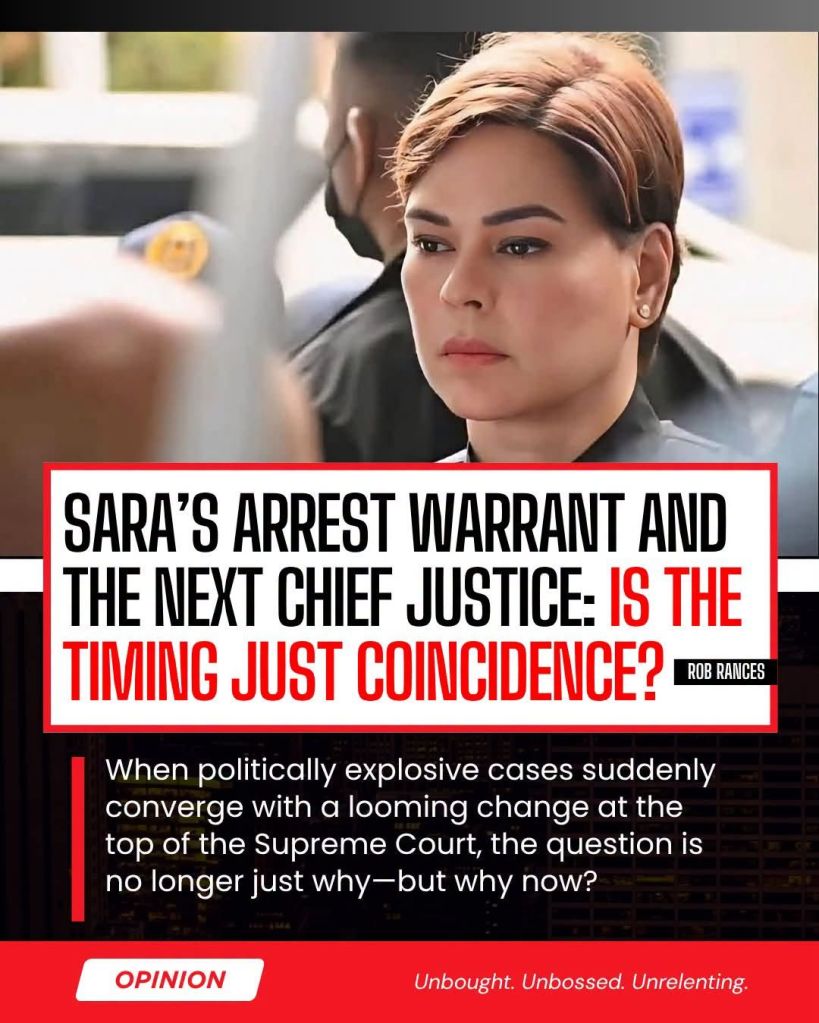
Something unusual is happening in Philippine politics now. In a remarkably compressed period, legal actions against prominent opposition figures have accelerated, most dramatically with the issuance of an arrest warrant against VP Sara Duterte.
To critics, the pattern increasingly looks like law being deployed as political attrition.
But strategic foresight requires us to look beyond individual cases and examine what else is converging.
Chief Justice Alexander Gesmundo retires on November 6. The Judicial and Bar Council has already begun the process of selecting his possible successor, and President Marcos will ultimately choose the next Chief Justice from the JBC shortlist—his first opportunity to appoint the head of the Supreme Court.
That timing matters. Not because we should assume that Supreme Court justices will compromise their independence to obtain the position. There is no evidence for that, and the Chief Justice cannot dictate Supreme Court decisions anyway: the Court is collegial, and the Chief Justice has one vote like every other justice.
But institutional incentives still matter.
When politically explosive constitutional controversies reach the Court at the same moment that several senior justices are potential candidates for an appointment controlled by the President, even the appearance of an incentive problem becomes consequential.
And the constitutional questions may soon be unavoidable.
The warrant against VP Duterte concerns the same alleged threats that form a central part of Article IV of her ongoing impeachment trial.
More significantly, the Supreme Court itself stated in its 2025 Duterte impeachment decision that an impeachable officer cannot be criminally prosecuted for the same offenses constituting grounds for impeachment while that officer remains in office.
That makes a Supreme Court challenge more than predictable; it makes the constitutional collision particularly serious.
So the foresight question is not: Will the Supreme Court side with Marcos because he chooses the next Chief Justice?
That would be speculation.
The more important question is this: Are we entering a political window in which increasingly aggressive uses of legal institutions will be tested before a Supreme Court that is itself approaching a consequential leadership transition?
If more constitutionally disputed actions against opposition figures emerge before November, the pattern deserves close scrutiny.
Because democratic erosion rarely announces itself by saying that institutions have ceased to function. Institutions continue functioning. Warrants are issued. Cases are filed. Hearings are conducted. Procedures are followed.
The danger begins when citizens can no longer confidently distinguish the rule of law from the strategic use of law.
And that is why the next few months may prove far more consequential than they presently appear.
•••
OPINION | ROB RANCES
Disclaimer: This commentary is an analysis of publicly reported events and institutional dynamics. It raises questions and possible scenarios for public discussion and does not allege wrongdoing, improper motive, or judicial misconduct by any person or institution.

