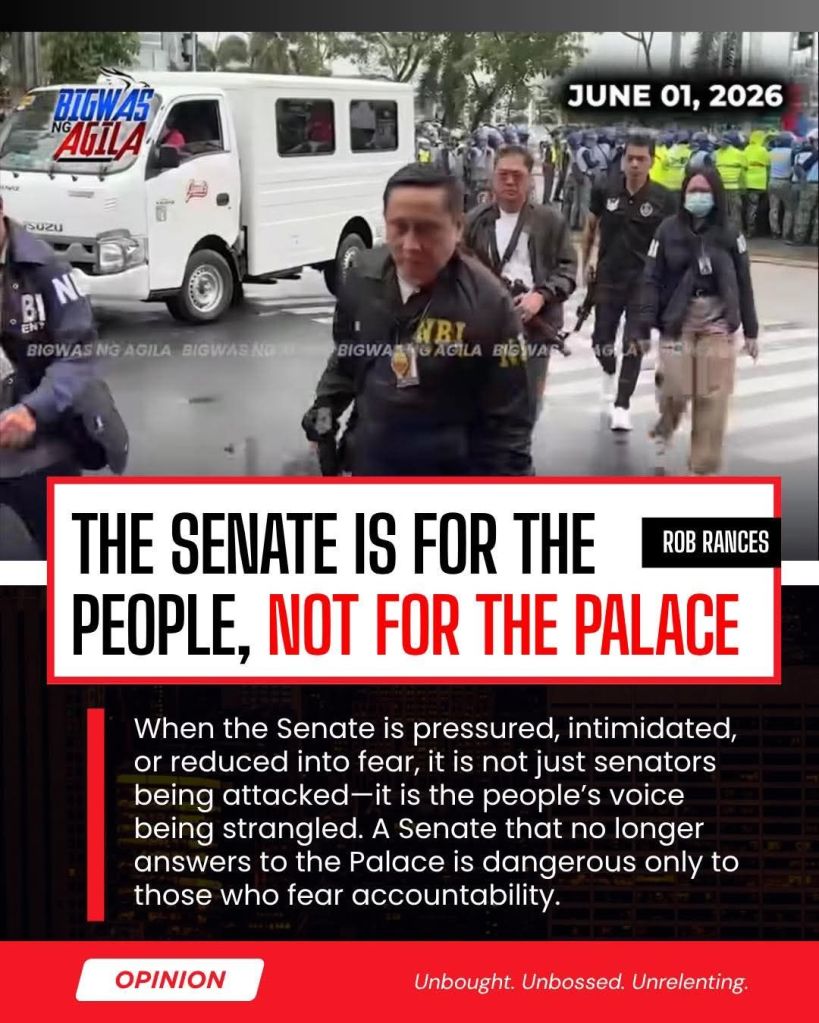
When a new Senate leadership emerges outside the grip of Malacañang, and almost immediately the institution is hit by legal pressure, security drama, quorum sabotage, and narrative attacks, we must ask: why now?
Senator Alan Peter Cayetano became Senate President after securing the support of 13 of 24 senators, forming a new majority at a moment of intense national conflict involving the ICC issue, the flood control scandal, and the coming impeachment trial of Vice President Sara Duterte.
That alone makes the Senate a decisive battlefield.
Whoever controls the Senate may control impeachment, investigations, budget scrutiny, and the political future of our country.
That is why the events that followed should offend every citizen.
The reported attempt by NBI agents to serve an ICC arrest warrant on Senator Bato dela Rosa inside the Senate was not a normal scene in a functioning democracy. News agencies reported that NBI agents tried to serve the warrant, that Dela Rosa ran toward the Senate plenary, and that allied senators placed him under protective custody. Reuters also reported a standoff inside the Senate building involving NBI agents and Senate security, with the Senate Sergeant-at-Arms later suspended after admitting he fired a warning shot.
Then came the cases against Senator Jinggoy Estrada, with the Ombudsman filing graft and plunder charges over the flood-control scandal. He denies the allegations, and due process must proceed.
But why does legal pressure appear to intensify precisely when the Senate majority becomes less controllable by Malacañang?
Even the walkout of minority senators during the debate on electronic voting was not a small procedural tantrum. It came during a dispute over rules that could determine whether absent or detained senators may still participate. In political effect, compromising quorum can weaken representation. And weakening representation weakens the people.
This is bigger than Bato, Jinggoy, or even Cayetano. This is about whether the Senate remains an independent constitutional body or becomes another obedient extension of executive power.
If the Palace, the House, and the Senate are all consolidated under one will, democracy is strangled procedurally.
So we must not merely watch. We must be offended. We must demand transparency. Demand due process. Demand respect for institutional independence. Demand that no branch of government be turned into a rubber stamp.
Because an attack on the independence of the Senate is an attack on democracy itself.
Protect the Senate. Protect the Republic.
Ang Senado para sa bayan, hindi para sa Palasyo.
••••
OPINION | ROB RANCES
This commentary is an opinion based on publicly reported events, political timing, and institutional implications. It does not assert guilt or criminal liability against any person or office, and all allegations must be resolved through due process and competent courts.

