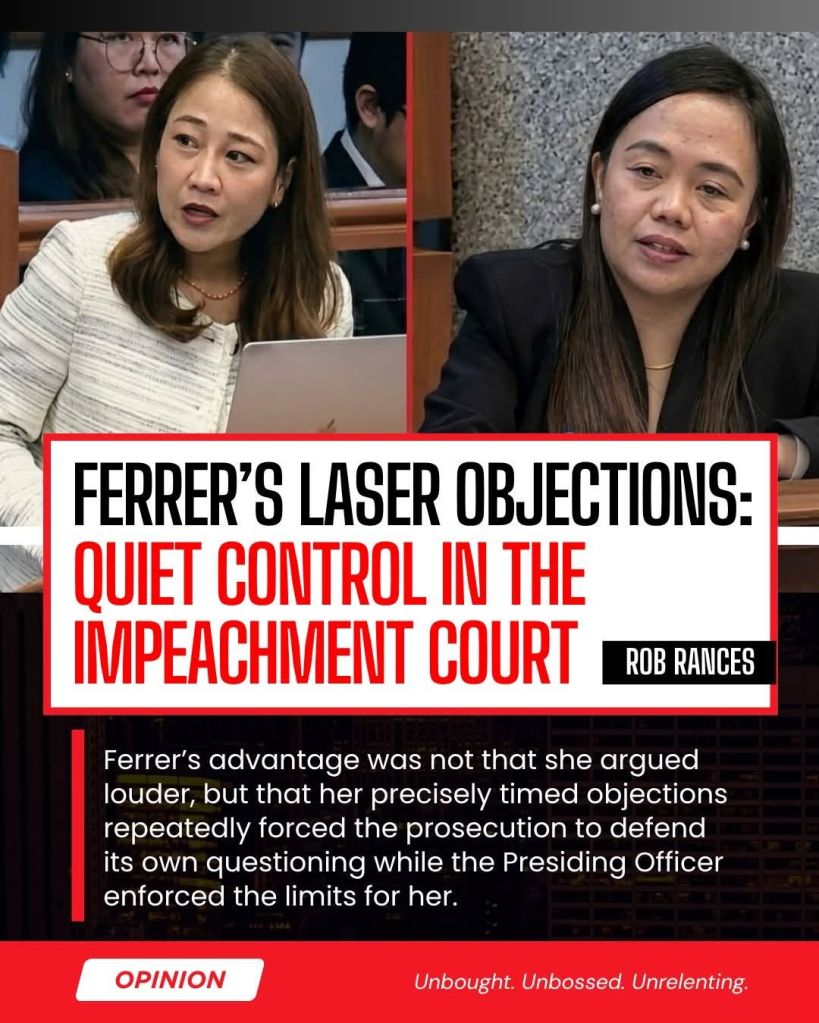
Ferrer did not need to out-speak Divinagracia. She did something far more effective: she made precision do the work of volume.
She waited for the vulnerability, objected narrowly, and secured the ruling.
I think that was not merely good courtroom discipline. It was strategic control.
Ferrer did not just break Divinagracia’s momentum. She forced something more strategically damaging to happen: the examiner suddenly became the one having to explain herself.
That is a serious reversal in litigation.
The prosecutor is supposed to keep the witness under examination, develop the facts, control the sequence, and steadily build the theory of the case. But once Divinagracia found herself defending her own words, characterizations, and manner of questioning, the center of gravity shifted.
For that moment, she was no longer advancing the case. She was defending the way she was advancing it.
And Ferrer barely had to say anything.
In coaching, we use what we call “laser questions”—short, precise interventions designed to penetrate directly into the assumption or weakness that matters most.
Watching Ferrer, I saw the courtroom equivalent: laser objections.
They demonstrated four characteristics:
1. PRECISION. Ferrer did not attack the entire line of questioning. She targeted the specific word, assumption, characterization, or premise that crossed the line.
2. TIMING. She objected at exactly the point when the prosecution’s characterization was about to become embedded in the testimony—not too early, and not after the damage had already been done.
3. BREVITY. She resisted the temptation to make a speech. That mattered. The longer the defense argues, the easier it becomes for the prosecutor to argue back. Ferrer instead gave Divinagracia very little room to turn the objection into another prosecutorial performance.
4. CONVERSION. This was the most powerful part. Ferrer succeeded in getting the Presiding Officer himself to articulate and enforce the limitation.
That changes everything.
The issue was no longer merely Ferrer versus Divinagracia. Once the Presiding Officer sustained the objection and imposed the boundary, Ferrer effectively converted her defense position into a ruling of the court.
And that was where the real advantage was won.
A skilled litigator is not measured by how hard or how long she argues, but by how precisely she identifies an opponent’s overreach and turns it into a tactical disadvantage. That, to me, was where Ferrer demonstrated superior litigation skill over Divinagracia: she needed only a well-timed objection to disrupt the prosecution’s momentum, force Divinagracia into explanation, and let the court itself enforce the limitation.
Ferrer showed why courtroom dominance is not necessarily measured by who speaks the longest or sounds the most dramatic.
Sometimes, it is measured by who can say the least and still force the other side to retreat, explain itself, and change course.
That is what Ferrer’s laser objection achieved: minimum words, maximum disruption.
••••
OPINION | ROB RANCES

