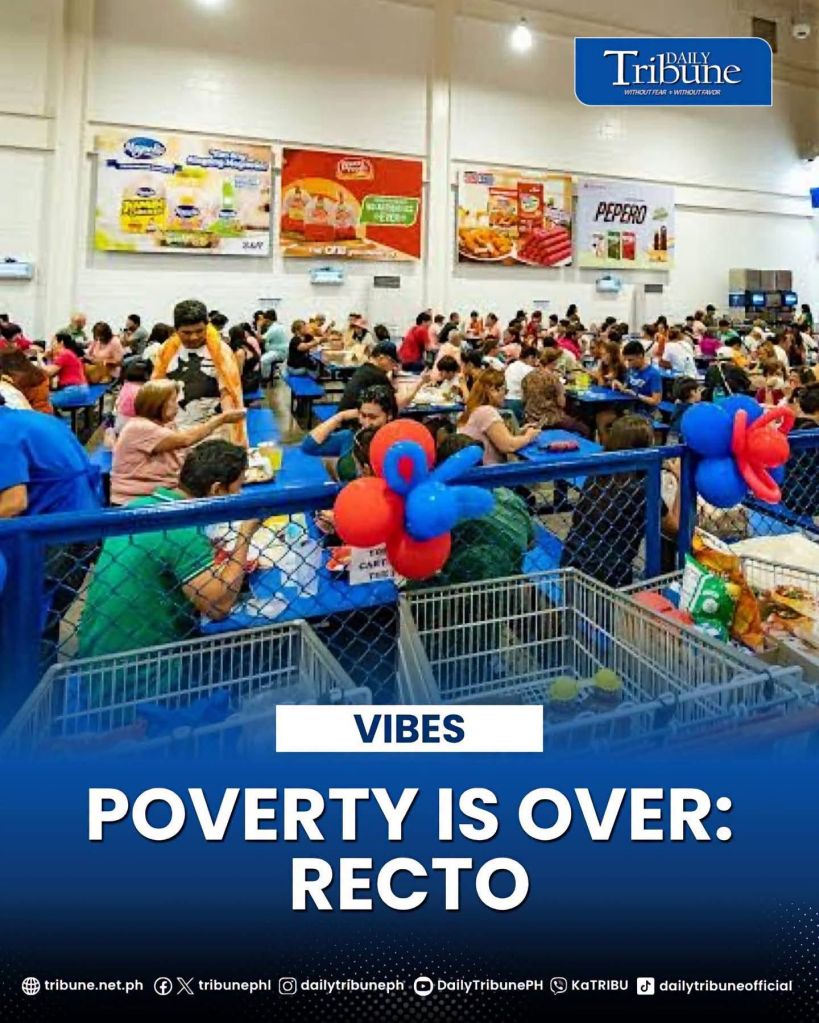
Ikaw na!
Before anyone makes a hero out of one statistic, ask the families still cutting meals, postponing medicine, and borrowing for emergencies: Has poverty truly retreated or has government simply declared victory at a very low finish line?
First, a necessary fact-check: Recto’s actual statement was that government must prevent 6.5 million Filipinos from falling back into poverty.
The official improvement should not be dismissed. According to the PSA’s preliminary figures, poverty incidence among individuals fell from 15.5% in 2023 to 9.7% in 2025. Mean incomes reportedly increased much faster than the poverty threshold.
Okay, that is progress—well, at least—under the government’s established methodology.
But what exactly does 9.7% mean?
It means 11.08 million Filipinos remained below an official poverty line averaging only ₱14,634 a month for a family of five. A family of five. Digest that. That’s about ₱487 for the entire family per day, or ₱97 per person for food, housing, electricity, water, transportation, medicine, education and every other basic need. A family earning ₱14,635 may therefore be classified as “nonpoor.” Its financial problems, however, do not disappear with that extra peso. Those are the government’s own thresholds.
The lived reality: hindi porke’t hindi ka na “poor” sa spreadsheet ay nakakaangat ka na sa totoong buhay. Nor does moving above the poverty line automatically make someone middle class.
The PSA’s survey income includes not only wages but transfers, pensions, gifts in cash or kind and even imputed rent—the estimated rental value of an owner-occupied home. These are methodologically valid resources, but they are not equivalent to a stable paycheck or cash available for groceries. The “6.5 million lifted” figure is also the difference between two population estimates. Hindi ito proof that the same individuals were followed and achieved lasting economic security, much less proof of exclusive government causation. The FIES itself is a sample survey with acknowledged limitations.
Now examine the numbers government cannot afford to place outside the frame:
1. In June 2026, 49% of Filipino families—around 13.6 million—considered themselves poor, while 36%, or 10.2 million families, considered themselves food-poor. Self-rated and official poverty measure different things, so one does not invalidate the other. But the enormous gap tells us that hardship extends far beyond the official cutoff. SWS also found that poor families have been lowering their own living standards through “belt-tightening.”
2. A 2026 study by the government think tank PIDS estimated that 30% of households were vulnerable to poverty. Meaning they are one illness, job loss, disaster or price shock away from falling below the line. Among vulnerable families, 86% suffered income volatility. Poverty measured at one moment is not the same as economic security.
3. In June 2026, 2.59 million Filipinos were unemployed and another 6.11 million were underemployed. Sila yung may trabaho but they still wanted more hours or additional work. Employment alone says little if the work cannot provide sufficient and dependable income.
4. In July, inflation for the bottom 30% of households reached 8.2%, compared with headline inflation of 6.2%. Food inflation for these poorer households was 8.5%, while rice inflation reached 19.3%. In other words, the families closest to poverty were experiencing the sharpest erosion of purchasing power.
5. And remember: the 9.7% figure describes 2025. It cannot pronounce poverty “over” in a 2026 economy where second-quarter growth slowed to 2.3%, household consumption grew only 2.8%, industry contracted 2.4%, and investment fell 9.2%.
This is why governance by selective statistics is dangerous.
If poverty is declared virtually solved, then there is supposedly no urgent problem left—only an official to congratulate. A single number can manufacture a hero while families wonder why their grocery baskets are getting emptier.
The correct conclusion is more modest: fewer Filipinos fell below a very low official threshold in 2025. That deserves recognition, but not a victory lap.
Poverty is not truly defeated when people merely cross a statistical line. It is defeated when work pays enough, food remains affordable, families can survive illness without borrowing, children can finish school, and one emergency does not push an entire household back into deprivation.
Government should not ask only, “How few people fit our definition of poor?” It should ask the harder, more honest question: How many Filipinos can actually afford to live securely and with dignity?
•••
OPINION | ROB RANCES
Disclaimer: This commentary is based on publicly available data and reports and constitutes opinion. It does not allege wrongdoing or assign exclusive causation to any person or administration.

